
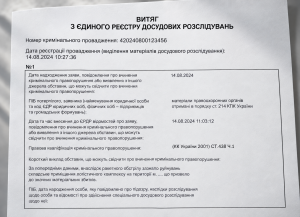
An extract from the ERDR is a key document for business after a missile or drone strike. A missile or drone strike on a warehouse, production facility, or vehicle fleet causes direct losses to a business. Following this, the company faces a specific challenge: without official recognition of the event as a criminal offense, it is impossible either to write off destroyed assets without the risk of additional tax assessments, or to receive an insurance payout, or to record the damage for future international compensation.
The document that resolves this task is an extract from the ERDR confirming the initiation of criminal proceedings regarding the strike. In the article, we explain how to properly submit a crime report, where to turn besides the police, and what to do if proceedings have not yet been initiated.
1. Why an extract from the ERDR is needed
The protocol of the scene inspection, the certificate or report of the State Emergency Service regarding the fire or destruction, and the photographic documentation of the damage are all important documents that record the fact and scale of the incident. However, along with them, for the tax authorities, the insurer, and the international Register of Damage, the most significant document is an extract from the Unified Register of Pre-trial Investigations (URPTI), which confirms that the state has officially recognized the incident as a criminal offense and initiated proceedings. Only within the framework of initiated proceedings does a company acquire the status of a victim and the right to petition for construction and technical, explosive-technical, and commodity-expert evaluations at the state's expense.
The tax authorities recognize the extract from the ERDR as one of the documents confirming force majeure when writing off destroyed assets (along with the SES act and the CCI certificate — p. Art. 198.5, Art. 198 of the Tax Code of Ukraine), and without it, an audit may treat destroyed property as a shortage, on which compensating VAT liabilities are accrued. The insurer requires the same document to pay out under the war risk policy. The International Register of Damage for Ukraine (RD4U), which has been accepting business applications for categories of damaged or destroyed assets since April 2026, also considers the ERDR extract as the main evidence in the application package.
2. Why registration in the housing and maintenance office is a problem
Registration of an appeal in the Single Accounting Log (SAL)—or, according to the police's modern terminology, in the «Information Portal of the National Police of Ukraine» (single accounting)—is not identical to entering information into the EPRE (Unified Register of Pre-trial Investigations). This is an internal accounting slip without a criminal proceeding number and without the status of a victim for the applicant.
The law of the investigator's duty defines clearly: under part 4 of article 214 of the Criminal Procedure Code of Ukraine, a statement about a criminal offense must be accepted and registered, refusal of registration is not allowed, and information is entered into the URBI no later than 24 hours from the moment of submitting the statement.
In practice, investigative units massively bypass this duty due to the workload following mass attacks and an unwillingness to ruin clearance statistics with proceedings under Article 438 of the Criminal Code of Ukraine, which cannot be solved in the near future. Even when materials are already being prepared for transfer by jurisdiction to the SBU, the proceeding in the ERDR may formally not be considered open.
3. How to properly submit a crime report
The wording «we ask you to conduct an investigation and bring the perpetrators to justice» does not contain signs of a specific criminal offense and opens the way for the investigator to enter it into the Journal of Operational Information (ZHEO). The statement must directly demand the entry of information into the Unified Register of Pre-trial Investigations (ERDR) on the grounds of a criminal offense under Part 1 of Article 438 of the Criminal Code of Ukraine («War Crimes»).
The application is accompanied by acts of inventory of assets, a scene inspection report and photographic documentation of damages, a SES certificate, a calculation of the book and replacement value of the property, and title documents for it.
The application should be submitted not only to the territorial police authority, but also separately to the prosecutor's office at the location where the criminal offense was committed; this may expedite obtaining an extract from the ERDR. The law also places the obligation to accept and register an appeal on the prosecutor (Part 4, Article 214 of the CPC of Ukraine), so a parallel appeal is an additional channel of control: if the police delay, the prosecutor's office, which exercises procedural supervision, has grounds to react on its own.
4. What to do if the investigator does not register the application
If the criminal proceeding number is not assigned within 24 hours, repeated appeals to the duty station are a waste of time. In such a case, the investigator's inaction must be appealed to the local court due to the failure to enter information into the URCE after receiving a crime report. In such cases, the court issues a ruling obligating the police to enter information into the URCE. The police authority complies with the court decision.
The deadline for submitting a complaint is ten days (Part 1, Article 304 of the Criminal Procedure Code of Ukraine). Formally, it is calculated from the moment of inactivity, i.e., after the expiration of the first 24 hours. The failure to enter information into the URDI (Unified Register of Pre-trial Investigations) is a continuing violation, so in practice, it is correct to tie the ten-day countdown to the moment when the applicant reliably learned about the fact of inactivity—usually the date of the official response from the police or prosecutor's office. This approach gives the lawyer time to prepare a high-quality complaint without violating the deadline. The ruling of the investigating judge granting the complaint is practically final.
BARGEN practice case
In September 2026, we handled a case where a drone attack on Kyiv destroyed a client's warehouse. The police only confirmed registration in the single record system and the parallel preparation of materials for transfer to the SBU—meanwhile, the proceeding in the URBI was not considered open. We filed a complaint with the district court demanding that the police enter information into the URBI under Part 1 of Article 438 of the Criminal Code of Ukraine within the ten-day period, obtained a court decision, and received an extract from the URBI. Taking into account the time for scheduling the hearing, obtaining the decision, and ensuring its enforcement, almost a month passed, but in the absence of other options, this is a truly working mechanism.
5. Why is the case being referred to the SBU
The first urgent actions—inspecting the scene and removing debris from weapons—are carried out by the territorial police, who arrive the fastest. After registering the information in the Unified Register of Pre-trial Investigations, the proceedings under Article 438 of the Criminal Code of Ukraine are transferred according to jurisdiction to the investigative bodies of the Security Service of Ukraine (Part 2, Article 216 of the Criminal Procedure Code of Ukraine), which is designated by law as the pre-trial investigation body for war crimes. The transfer of case files between agencies is the moment when a case most often stalls without lawyer oversight: the new investigator receives the materials with a delay, and the applicant is left without information about the status of the proceedings for weeks.
6. Why a lawyer is needed from the first hours
Legal support in the first hours after an attack solves several tasks simultaneously. First of all, a lawyer controls the correctness of the crime scene inspection and the procedural recording of physical evidence: the fragments of the weapons used must be seized and documented.
In parallel attorney prepares a statement to the police and the prosecutor's office with the correct qualification under Article 438 of the Criminal Code of Ukraine and a complete package of attachments. This removes the investigator's formal pretext to register the appeal in the log of incoming documents instead of the Unified Register of Pre-trial Investigations.
If the investigator does not respond within a day, the lawyer immediately prepares a complaint under Articles 303–304 of the Criminal Procedure Code of Ukraine, without waiting months for the situation to resolve itself. They also control the transfer of the proceedings materials according to jurisdiction to the SBU and coordinate the damage assessment for the tax authority, the insurer, and the Register of Damage Caused for Ukraine.
Checklist of actions after a strike on a business
In the first hours after the strike, it is important to record the event with photo and video before cleanup begins and to call the State Emergency Service and the police. Debris should not be cleared, and damaged structures dismantled, until the scene inspection is complete: this destroys evidence needed for subsequent expert examinations.
At the same time, a lawyer should be engaged to prepare a criminal offense report under Part 1 of Article 438 of the Criminal Code of Ukraine, complete with a full package of attachments. The statement is submitted simultaneously to the police and the prosecutor's office at the location where the offense was committed, demanding registration specifically in the Unified Register of Pre-Trial Investigations rather than in the unified records.
If the criminal proceedings number is not assigned within 24 hours, the next step is to file a complaint with the investigating judge under Articles 303–304 of the Criminal Procedure Code of Ukraine. After receiving the extract from the Unified Register of Pre-trial Investigations, a copy of it is submitted to the accounting department to adjust tax liabilities, to the insurer to receive payment under the war risk policy, and added to the application to the Register of Damage for Ukraine. At the same time, it is advisable to monitor the transfer of the case materials according to investigative jurisdiction to the Security Service of Ukraine (SBU) so that the case does not get lost between agencies.