We explain in the article what is happening to the industry without current regulation, how cryptocurrency is taxed today, and what to expect if the law is eventually passed.
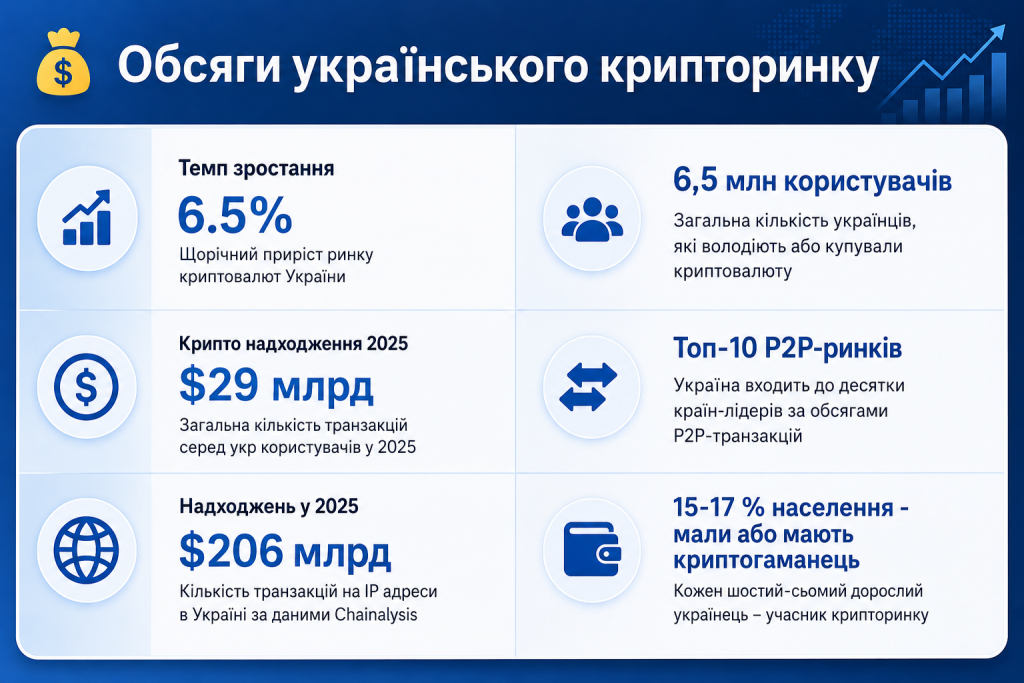
Ukraine remains one of the most active crypto markets in the world even in times of war. The demand for digital assets is only growing due to currency restrictions, the search for alternatives to traditional banking services, and the need for fast international transfers. At the same time, the market still lacks the main thing: a legislative framework. The law «On Virtual Assets,» passed back in 2022, has never entered into force because this requires amendments to the Tax Code of Ukraine, which have still not been adopted.
In this article, we will discuss the current state of cryptocurrency regulation in Ukraine in 2026: what legislative framework is already in place (if any), how digital asset transactions are taxed today, what fines the latest draft law introduces, and what the entry into force of the European MiCA regulation means for Ukrainian business.
Legislative framework: what went wrong?
Ukraine has gone through three legislative attempts to regulate the circulation of cryptocurrencies and digital assets:

According to preliminary data, the adoption of the law is expected by the end of the summer of 2026, but this date has been postponed repeatedly.
However, if the law is nevertheless adopted, what should the Ukrainian crypto market expect?
What does bill No. 10225-d propose
Cryptocurrency as property, not money
A virtual asset is defined as a digital thing, meaning cryptocurrencies are equated to movable property. This means that the general provisions of the Civil Code concerning movable property apply to the creation, transfer, and storage of virtual assets.
In the current draft of the bill, virtual assets are not recognized as a means of payment and cannot be exchanged for goods or services, except in cases directly provided for by law.
Token categories
- Asset-referenced tokens (ARTs) maintain a stable value by pegging to another asset, right, or a combination thereof (in particular, several official currencies). The issuer of such a token may not own the asset to which the token is pegged.
- Electronic Money Tokens (EMT), or the well-known stablecoins, maintain a stable value by being pegged exclusively to a single official currency.
- Other tokens - everything else; specific subtypes will be determined by the regulator.
Virtual assets DO NOT include: digital hryvnia (issued by the NBU), as well as objects already qualified as financial instruments, deposits, electronic money, securitization positions, insurance products, pension payouts, or other regulated financial services.
Authorization (VASP services)
The provision of services related to virtual assets will require obtaining the status of a virtual asset service provider (VASP). For companies that are already licensed in EU member states and other states determined by the regulator, a simplified authorization procedure is provided.
For institutions that already hold financial licenses, in particular banks, non-bank financial institutions and postal operators with an NBU currency license, depository institutions, investment firms, organized capital market operators, and electronic money institutions, an even simpler procedure is provided: submitting a notification to the regulator, which will allow them to offer virtual asset services alongside other financial services.
The draft law also proposes to preserve the reverse solicitation rule: a foreign provider can serve a Ukrainian client without authorization if the client initiated the contact independently, without active solicitation or advertising in Ukraine by the provider.
Which services specifically require authorization
- storage and administration of virtual assets;
- trading platform operator activities;
- exchange of virtual assets for monetary values;
- exchange of virtual assets for other virtual assets;
- execution of orders for virtual assets on behalf of clients;
- placement of virtual assets;
- virtual asset transfer services;
- receipt and transmission of orders for virtual assets on behalf of clients;
- virtual asset consulting services;
- virtual asset portfolio management.
Regulator: there should be two of them, but so far only one has been decided on
Currently, only the regulator for electronic money tokens has been determined: it is the National Bank of Ukraine. Who will regulate the rest of the virtual assets market is to be determined later by the Cabinet of Ministers of Ukraine.
How crypto income is taxed today
Until the special law enters into force, income from operations with virtual assets is formally taxed as other personal income under the general norms of the Tax Code. In practice, however, most market participants do not declare such income due to the lack of a transaction tracking mechanism and the vagueness of current regulations.
The main problem with applying general tax rules to crypto income is that the combined rate of 23% (18% personal income tax and 5% military levy) is applied to the entire amount withdrawn in hryvnia or foreign currency, rather than to the net profit. In other words, the tax authorities currently do not allow taxpayers to officially reduce their taxable income by the amount of expenses incurred in acquiring the cryptocurrency.
The rates proposed by draft law No. 10225-d

VAT: emission, placement, sale, exchange, and redemption of virtual assets are dismissed from VAT, except for virtual assets with «individual characteristics» (such as NFTs) and those that grant the right to demand the transfer of property or the provision of a service, which remain taxable. Services related to the circulation of virtual assets, except for consulting services, are also exempt from VAT.
Tax amnesty: A chance to legalize at a discount
The draft law provides for a preferential regime for owners of virtual assets acquired before the entry into force of the new law: in case of sale of such assets in 2026, one can voluntarily choose a personal income tax rate of 5% instead of the standard 18%. Explaining the sources of funds for the acquisition of the asset is not required. It is likely that this grace period will be extended given the delay in the adoption of the law.
Fines
The regulator and the NBU will have the right to apply enforcement measures of varying degrees, from written warnings and public disclosure of the fact of a violation to the temporary or complete revocation of authorization and a ban on exercising management functions (for up to 10 years). Separately, quite high fines are provided for:
- Individuals: up to UAH 28 million for general violations; UAH 40–200 million for insider trading or market manipulation.
- Legal entities: up to 200 million UAH or 3-12.5% of annual turnover (depending on the type of violation), whichever is greater applies.
- Market abuse (insider trading, manipulation): up to UAH 600 million or 15% of annual turnover for legal entities; up to UAH 200 million for individuals.
- Failure to comply with the decision to ban trade: a fine for individuals of 5 thousand to 10 thousand non-taxable minimum incomes of citizens.
- Illegal advertising of virtual assets: individuals up to 21 million UAH; legal entities up to 150 million UAH (no more than 3% of turnover).
- Providing false information or destroying evidence: 1 thousand to 5 thousand non-taxable minimum incomes.
Importantly: The text of the bill after the second reading may differ significantly from the current version. This article will be updated after the final version of the law is adopted.Will Ukraine manage to avoid the impact of MiCA
In the European Union, there is a single regulation on crypto-asset markets, MiCA (Markets in Crypto-Assets), by which member states must be guided when adopting national norms for regulating the crypto market.
On July 1, 2026, the transition period for European companies came to an end. After this date, crypto companies without a CASP (Crypto-Asset Service Provider) license cannot legally provide services to clients in the EU.
Although Ukraine is not yet an EU member, MiCA regulations must be implemented into the country's legislation as one of the conditions for its accession. The NKCPFR, in cooperation with international partners, is working on the relevant regulations. However, it is important to consider that Ukrainian regulations need to be adapted to the realities of the domestic market in order for them to be effective. This is precisely the complexity in the process of harmonizing EU requirements, MiCA standards, and Ukrainian market needs.
Conclusions and recommendations
The digital asset market in Ukraine in 2026 is in a transitional phase from a de facto unregulated yet mass phenomenon to a formalized legal infrastructure. At the same time, pressure is also coming from the outside: starting July 1, 2026, the market has effectively split into a MiCA-compliant segment (for working with EU clients) and a local one. Ukrainian companies with international ambitions will have to simultaneously obtain CASP licenses in one of the EU countries or enter other markets.
How to prepare for the adoption of the law right now?
If you are an individual with crypto assets
- Start collecting documentary evidence of transactions: exchange statements, transaction confirmations.
- Avoid cashing out virtual assets through unregulated providers: this increases the risk of actions being classified as tax evasion.
- After the law enters into force, consider the option of legalizing previously acquired assets at a preferential rate, if it remains in the final version.
If you are a VASP provider or crypto business
- Prepare your AML program and Travel Rule procedures according to EU standards right now.
- Consider obtaining a CASP license in one of the EU countries to legally work with EU clients.
Provided that regulatory reform is completed, Ukraine has all the prerequisites to become a regional hub for the Web3 industry in Eastern Europe thanks to moderate tax rates and relatively lower capital requirements.
How and to whom Bargen can help
While virtual asset legislation is in a transitional state, every decision, from business structuring to income declaration, should be made with legal support.
- To crypto asset owners We help assess the tax risks of current operations, prepare documentary evidence for transactions, and plan the legalization of assets after the new law enters into force.
- To VASP providers and crypto businesses we assist with corporate structure, support the acquisition of CASP/VASP licenses in the EU and the UAE, develop internal policies, analyze tokenomics, and provide opinions on token types.
- To Investors We conduct legal audits of Ukrainian companies operating with virtual assets and help structure transactions to minimize regulatory risks.
- A business working with foreign clients, We help determine whether a CASP license is required in a specific case and choose the optimal jurisdiction to obtain authorization.
If you need advice on cryptocurrency taxation, obtaining a VASP or CASP license, or assessing regulatory risks, the Bargen team is ready to analyze your situation and offer a specific action plan.
Frequently Asked Questions about the Digital Asset Market (FAQ)
Is cryptocurrency legal in Ukraine in 2026?
Cryptocurrency is not officially banned, but it also lacks a clear legal status: a special law has not yet entered into force. Operations with virtual assets take place in a gray zone, and income from them is formally taxed under general rules.
Do crypto earnings need to be declared right now?
Formally speaking, income from the sale of virtual assets is subject to taxation at a rate of 23% (18% personal income tax and 5% military levy) on the entire amount withdrawn into fiat. In practice, there is currently no mechanism for the forced tracking of such transactions, but this does not exempt one from the obligation to declare them.
When will bill No. 10225-d enter into force?
The exact date is still unknown. The bill is in the stage of preparation for the second reading, after which it still has to be passed by the Verkhovna Rada and signed by the President. According to the latest information, the adoption of the law is expected by the end of the summer of 2026, but these deadlines have already been postponed repeatedly.
What will change for cryptocurrency owners after the adoption of the law?
Key change: the ability to legalize previously acquired assets at a preferential personal income tax rate of 5% instead of the standard 18%, without the need to explain the sources of funds for the acquisition.
Does MiCA apply to Ukrainian companies that do not operate in the EU?
Not directly, unless the company serves customers in the EU. But if there are EU residents among the customers, or if the company plans to attract European investors or partners, obtaining a CASP license becomes mandatory.
Where to go for a consultation on crypto regulation?
The Bargen team advises on taxation of virtual assets, obtaining VASP and CASP licenses, and also supports transactions for investors and businesses dealing with crypto assets.
This article is for informational purposes only and does not constitute legal advice. The information provided reflects the state of legislation at the time of publication and may be outdated due to dynamic changes in the regulatory framework. To assess the specific circumstances of your enterprise, please seek personalized legal advice.